As a rubber covered yarn supplier, I get asked this question all the time—by startup apparel brands scaling their loungewear lines, by industrial fabric manufacturers needing durable elastic for conveyor belts, and even by small craft shops sourcing materials for handmade swimwear. It’s a fair question, too: rubber covered yarn (RCY) is a specialized product, and its performance stands or falls on how closely it meets defined quality standards. Over 12 years in this business, I’ve learned that “good” RCY isn’t just about feeling stretchy—it’s about consistency, longevity, and reliability across every yard. Let’s break down what those quality standards actually look like, and why they matter for your projects. Rubber Covered Yarn
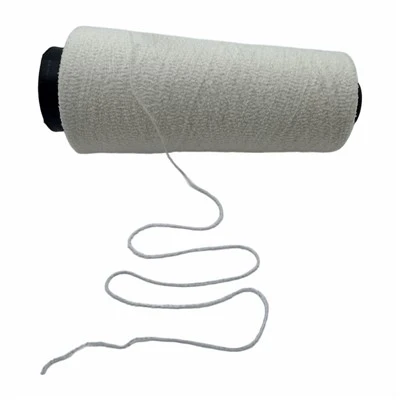
First, let’s start with the core material: the rubber core. That’s the elastic heart of the yarn, and its quality sets the foundation for everything that comes after. Most RCY uses either natural rubber (NR) or synthetic rubber (like neoprene or polyester-based elastomer) for the core. Natural rubber is prized for its high elasticity and low compression set, which means it bounces back to its original length repeatedly without losing shape. Synthetic rubber, on the other hand, offers better resistance to chemicals, UV rays, and extreme temperatures—making it ideal for outdoor gear or industrial applications. But whatever core you choose, there are hard standards to track here. We test the core’s tensile strength first: it needs to withstand at least 20 MPa (megapascals) before breaking, though for high-stakes uses like athletic wear, we aim for 28 MPa. Then there’s compression set, the measure of how much the core deforms after being stretched and held for a set time. For most consumer goods, compression set should stay below 15% after 72 hours at 70°C; for industrial parts, that number drops to 10%. I’ve seen suppliers cut corners here: use a low-grade rubber core, and your RCY will sag after a few washes, a disaster for leggings that lose their waistband stretch after three wears.
Next, the covering yarn—the outer layer that wraps around the rubber core. This isn’t just decorative; it’s what protects the core from friction, moisture, and abrasion. Common covering materials are polyester, nylon, cotton, and even spandex blends, each suited for different uses. For example, cotton covers are soft against skin, perfect for baby onesies, while nylon covers are more durable, ideal for swimwear that’s exposed to chlorine. But the quality standard here boils down to cover twist and uniformity. Twist rate is the number of turns per inch (TPI) in the covering yarn: too low, and the core isn’t fully protected, leading to fraying; too high, and the yarn becomes stiff and loses elasticity. We stick to a TPI range of 15 to 25, depending on the core’s thickness, and test every batch to ensure it doesn’t vary more than 2 TPI from the specification. Uniformity is another big one. A good covering yarn has consistent thickness along its entire length—no thin spots, no lumps. If the covering is too thin in one area, the rubber core will show through, or the yarn will break under tension. In our factory, we use an electronic yarn clearer to spot any irregularities larger than 0.1 mm; any yarn that fails that test is rejected before it even makes it to our customers.
Then there’s the finished yarn’s stretch and recovery, the two metrics that define functional RCY. Stretch is how much the yarn can elongate before breaking; recovery is how well it bounces back. For apparel, the standard stretch is 300% to 500%—meaning a 10 cm yarn can stretch to 30–50 cm before snapping. For industrial applications, stretch might be lower, around 200% to 300%, to handle heavy loads. But recovery is where many RCYs fall short. A high-quality RCY should have a recovery rate of at least 95% after 10 stretch-and-release cycles. I once had a client come to me with a batch of leggings that kept slipping down, and it turned out their previous supplier’s RCY only had an 82% recovery rate—each wear stretched the yarn a little more, until it lost all shape. To test this, we use a tensile tester that pulls the yarn to its specified elongation, releases it, and measures the remaining length after 30 seconds. If the recovery is below 95%, it’s not leaving our warehouse.
Durability and resistance are also non-negotiable quality standards, especially for products that see frequent use. Laundering is a big one for consumer goods: RCY needs to hold up to repeated washing, including exposure to detergent, hot water, and tumble drying. We test for wash durability by running 50 wash cycles in a standard laundry machine at 40°C, then checking for changes in stretch, recovery, and cover integrity. A good RCY will have less than a 5% drop in stretch after those cycles, and the covering won’t show signs of pilling or fraying. For swimwear or outdoor gear, we add resistance to UV radiation and chlorine: after 100 hours of UV exposure (simulating a year of outdoor use), the RCY should retain at least 90% of its original tensile strength. Chlorine resistance is tested by soaking the yarn in a 5% chlorine solution for 24 hours; again, a quality RCY won’t lose more than 10% of its stretch. Industrial RCY, used in things like gaskets or conveyor belting, also needs resistance to oils and chemicals—another area where cutting corners leads to early failure.
Beyond material and performance, there are process-related quality standards that go into making RCY. Let’s talk about linear density, or how much a given length of yarn weighs. This is critical for consistency, especially for bulk orders. If one spool of 200 denier RCY is actually 180 denier, your end product will have uneven elasticity—some parts will be tight, some loose. We measure linear density with a wrap reel and a precision balance, ensuring each spool is within ±2% of the specified denier or tex. Evenness of diameter is another process standard: the RCY’s total diameter (core plus cover) should be consistent within ±5% across the entire spool. We use laser micrometers to check every batch, because even a 10% variation in diameter can cause issues in knitting or weaving machines, leading to broken threads or inconsistent fabric.
Then there’s adhesion between the rubber core and the covering yarn. If the two layers separate, the yarn becomes useless—no protection for the core, no stretch retention. Adhesion is tested by pulling the cover away from the core at a 180-degree angle; the force required to separate them should be at least 5 cN (centinewtons) for consumer RCY, and 10 cN for industrial grade. In our production, we treat the rubber core with a special adhesive coating before covering it, which bonds the two layers permanently. I’ve seen cheap suppliers skip this step, leading to RCY that peels apart after the first stretch—avoid that, and you’ll save yourself a lot of returns.
Testing standards themselves also matter. A quality RCY supplier will have a formal quality control (QC) process, not just guesswork. We test every batch at three stages: after the rubber core is extruded, after the covering is applied, and in the final finished spools. We use standardized test methods from organizations like ASTM International, so our results are consistent and reliable—no arbitrary thresholds. For example, ASTM D2731 is the standard test method for rubber covered yarn tensile strength and elongation, and we strictly follow those protocols. I’ve worked with clients who switched from a supplier that used “internal” tests only, and they were shocked at how much more consistent our RCY is. Independent testing, like third-party lab audits, is another mark of a reliable supplier—we get our RCY tested quarterly by a ISO-certified lab to confirm our processes are holding up.
Now, why do these standards matter for you, the customer? Whether you’re a small fashion brand or a large industrial manufacturer, RCY that meets these quality standards saves you money in the long run. Poor RCY leads to product returns, brand damage, and waste—things no business can afford. Let’s use a retail example: if you’re making 10,000 leggings with low-quality RCY, you might save a few cents per yard on material, but if 5% of your customers return the leggings because the waistband loses stretch, that’s 500 returned units, processing fees, and negative reviews that hurt your sales. For industrial clients, a conveyor belt made with low-quality RCY might fail after 6 months, leading to costly downtime. I’ve had a automotive parts client come to me after a bad batch of RCY caused a production line shutdown—they went from a different supplier to us, and now we’ve been their exclusive RCY provider for 8 years.
But here’s the thing: not all RCY is one-size-fits-all. The right quality standards depend on your end use. A craft maker making handmade headbands might only need basic RCY that meets a 300% stretch and 90% recovery rate, while a performance activewear brand needs RCY that meets the full set of wash, UV, and tensile standards. That’s why we work closely with every client to tailor our RCY to their needs—we don’t just send a generic batch. For example, last year we worked with a startup making adaptive clothing for people with mobility issues, who needed RCY that was gentle on skin (so we used a cotton-poly blend cover) and had a low stretch rate to avoid gaping. We adjusted our production to meet their specific requirements, something that off-the-shelf RCY can’t do.
I know navigating RCY quality standards can feel overwhelming, especially if you’re new to sourcing. That’s why as a supplier, we’re always transparent about our processes and test results. We’ll send you batch test reports on request, explain the difference between natural and synthetic rubber cores, and help you choose the right RCY for your project. There’s no reason to guess when it comes to a material that’s the backbone of your product.
At the end of the day, quality standards for rubber covered yarn aren’t just numbers on a spec sheet—they’re promises. A 95% recovery rate means your leggings will keep their shape wash after wash. A 28 MPa tensile strength means your industrial gaskets will hold up under pressure. A consistent TPI means your knitting machine will run smoothly, no broken threads mid-production. For over a decade, I’ve built this business on delivering on those promises, because I know how much rides on the materials we supply.
If you’re sourcing RCY and want to make sure you’re getting a product that meets these quality standards, I’d love to chat. Whether you’re a small brand or a large manufacturer, we can walk through your requirements, share our test results, and find the right RCY for your needs. Don’t settle for subpar RCY that will cost you time and money—reach out, and let’s make sure your project has the stretch and durability it needs to succeed.
Air Nylon Covered Yarn References
ASTM International. Standard Test Method for Rubber Covered Yarn (D2731). ASTM International, West Conshohocken, PA.
ISO 1806:2019. Rubber covered yarns for textiles – Specifications. International Organization for Standardization, Geneva.
Textile Institute. “Rubber Covered Yarn: Properties and Applications.” Textile Progress, vol. 45, no. 3, 2013, pp. 207–249.
Zhuji Yuanhui Import & Export Co., Ltd.
Zhuji Yuanhui Import & Export Co., Ltd. is one of the most professional rubber covered yarn manufacturers and suppliers in China. With abundant experience, we warmly welcome you to buy high-end rubber covered yarn made in China here from our factory. If you have any enquiry about quotation and free sample, please feel free to email us.
Address: No.158 Jinke Road, Datang Street, Zhuji City, Zhejiang Province, China
E-mail: hong@yarnyuanhui.com
WebSite: https://www.yarnfty.com/
